Yacht Toys & Equipment Split Croatia — 2026 Adriatic Catalog
Complete 2026 catalog of yacht toys for catamaran charters from Split — e-foils, jetskis, Seabobs, slides, fitness, cinema with weekly prices.
Read more
Updated May 2026.
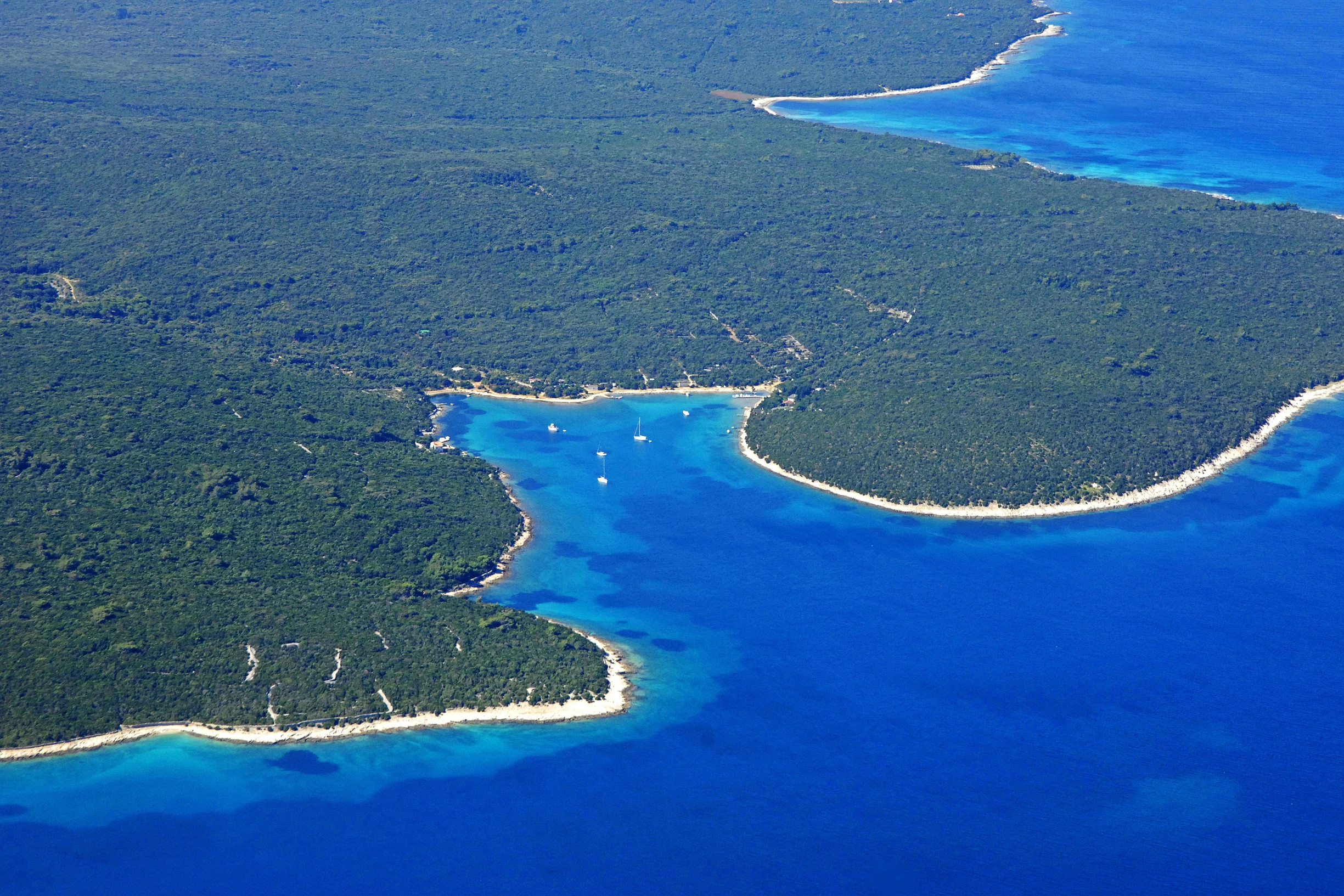
Vis is the most distinctive island in central Dalmatia — Yugoslavia’s military-closed island until 1989, still a working fishing economy, the westernmost inhabited Croatian island and the one with the clearest water. A catamaran week that pushes 30 NM offshore from Split or Trogir reaches a different rhythm — fewer charter boats, smaller villages, two of the most cinematic anchorages in the Adriatic (Stiniva and Biševo’s Blue Cave), and a strong taverna culture rooted in fresh fish and local wines. This guide is the working catamaran-charterer’s reference to the 11 Vis stops you should not miss, with anchorage detail, the operational wind notes, and a 5-7 day loop from Split or Trogir at the end. For the wider Croatian picture see our Catamaran Charter Croatia 2026 complete guide.
Vis town sits on the deep northeast bay and is the working capital of the island. Roman wreck museum, old British naval cemetery, a long seafront promenade. Anchorage: stern-to on the town quay (€40-80 in season) or free anchoring in 6-10 m on sand-and-weed. Well-sheltered from the prevailing northwest maestral but exposed to the southerly jugo — move to the south or west side if a serious jugo is forecast. Pojoda or Val for traditional Dalmatian dinner.
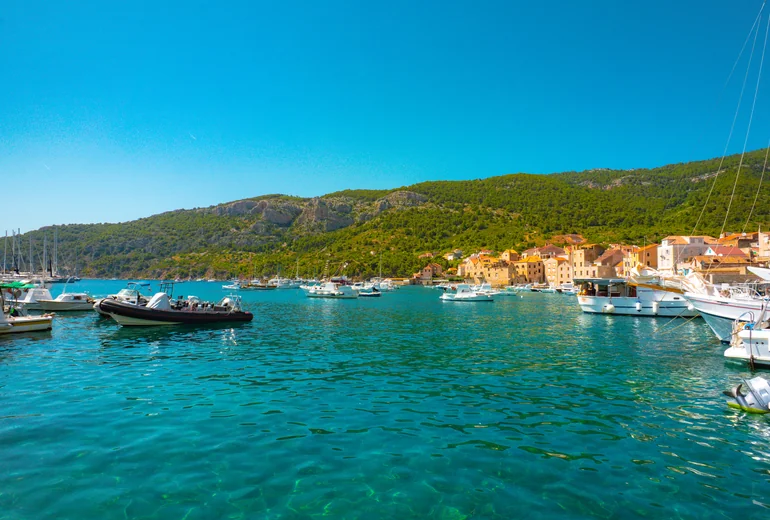
Komiža is the smaller harbour on the west side, 8 km across the island from Vis town — narrow, atmospheric, stone houses pressed against the seafront, a working fishing fleet, visible WW2 naval history. Anchorage: inner harbour stern-to (€30-60, limited); larger cats anchor in the outer bay in 6-12 m sand. Sheltered from the maestral by the headland; exposed to westerlies. Launching point for the Blue Cave at Biševo (5 NM south).
Stiniva is a tiny pebble beach inside a near-circular amphitheatre on Vis’s south coast — two limestone cliffs almost meeting overhead, a narrow gap to the open sea. “European Beach of the Year 2016” and the crowding is real. Anchorage: outside the cove in 8-15 m on sand; dinghy or swim in. The cove is too narrow for catamarans. Critical timing: arrive before 10:00 — day-tripper boats from Split and Trogir saturate the bay from 11:00 onwards.
The Blue Cave on Biševo islet, 5 NM south of Komiža, is the marquee Vis attraction — sunlight refracting through an underwater entrance illuminates the cave interior in saturated blue between approximately 11:00 and 12:00. You cannot enter the cave on your own catamaran or dinghy — entry is exclusively via licensed local small-boats from Mezuporat dock on Biševo. Anchor in Mezuporat bay, buy the entry ticket (approximately €20 per person in 2026), board a small wooden boat for the 10-minute interior visit. Queue can be 60-90 minutes in peak season — arrive at Biševo by 09:30.
Ravnik islet between Vis’s south coast and Biševo. The Green Cave is the quieter alternative — accessible directly by dinghy or swim, no queue, no fee. The interior glow is greener; the swim-through is genuinely possible in calm conditions. Anchor outside in 8-15 m sand-and-pebble, exposed in southerlies. Pair with the Blue Cave for a full Day-on-Vis itinerary.
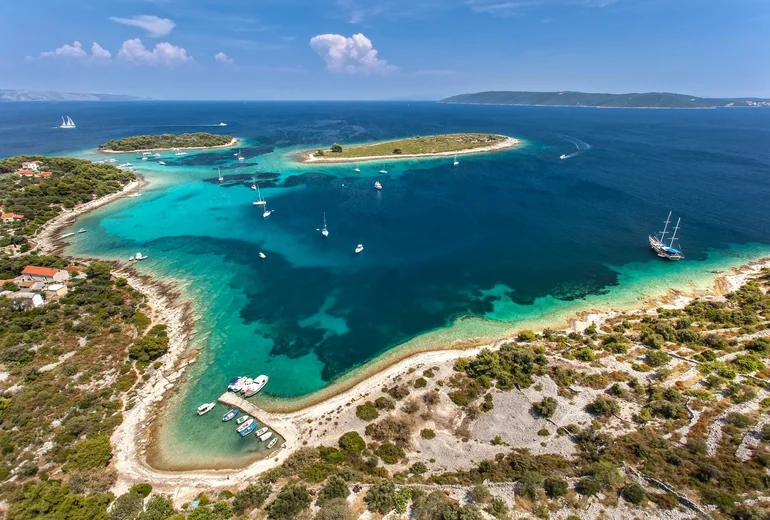
Stončica sits 4 NM east of Vis town. A long sand-bottom bay with a small church, beach taverna, and one of the few proper sandy beaches in central Dalmatia. Anchorage: 4-9 m sand, sheltered from southerlies, exposed to the northerly bura. Kid-friendly, shallow water 50 m from shore.
Pebble beach on Vis’s southeast coast, 5 km from Vis town. A small gravel cove between low limestone cliffs, single beach taverna, panoramic views of the open Adriatic. Anchor in 6-10 m sand-and-pebble, exposed in southerlies. Best as a swim-and-lunch stop between Vis town and Stiniva.
Budikovac is a small islet 1.5 NM south of Vis’s east coast — its interior holds a shallow turquoise lagoon almost completely enclosed by rocks. Anchorage: outside the lagoon in 6-12 m on sand; tender in for swimming (the entrance is too narrow for a catamaran). One family-run taverna ashore. Combine with Stončica or Srebrna for a full east-coast day.
Vis was the headquarters of Tito’s partisan resistance in WW2 — his command bunker sits on the slope of Mount Hum (587 m, the island’s highest peak). Access by a 90-minute signed hike from Komiža or by scooter/taxi to the cave parking lot. Preserved historical site, small entrance fee in season. From the cave the hike continues to the summit — panoramic views over the central Dalmatian archipelago. Allocate a half-day; bring water and sturdy shoes.
Vis grows two indigenous varieties — Vugava (white) and Plavac Mali (red). Several small family wineries open to charter visits — Lipanović and Roki’s are the standard reservation-only options. Taverna picks: Konoba Stončica (at the beach, fresh fish), Pojoda (Vis town, traditional Dalmatian), Roki’s (interior, slow-cooked lamb under the bell). Tavernas book days ahead in peak season.
Vis carries the highest density of Cold War-era naval infrastructure of any inhabited Croatian island. Reinforced-concrete submarine tunnels at Parja Bay (south coast) and Rogačić Bay (west coast) were built to hide Yugoslav-navy submarines. Both accessible by dinghy from a nearby anchorage; some interiors open to exploration (torch needed). Pair with the Tito’s Cave hike for a full modern-history day.
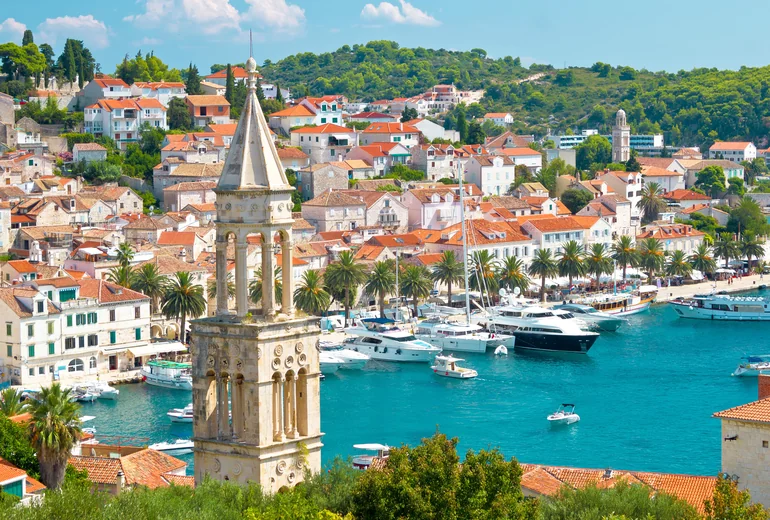
Vis sits 15 NM east of the Pakleni archipelago and Hvar town. The Pakleni — a dense cluster of small islands just south of Hvar — is the standard inter-island leg from Vis. Most catamaran weeks combine 2-3 days on Vis with 2-3 days on the Pakleni and Hvar. See our Hvar and Pakleni coverage on the island-hopping from Trogir family week plan and 7-day Split-to-Dubrovnik itinerary.
Day 1 (Sat eve): Split or Trogir → Maslinica, Šolta (12 NM). Easy first night, mooring buoy or anchor in the bay. Konoba dinner in the village.
Day 2: Maslinica → Vis town (28 NM). Longer downwind leg in the typical maestral. Anchor in the outer bay or take a town-quay berth. Evening walk along the seafront, dinner at Pojoda or Val.
Day 3: Vis town → Komiža via Stiniva (15 NM). Early-morning detour to Stiniva (arrive 09:00), continue to Komiža for the night. Dinner at Konoba Bako on the harbour.
Day 4: Komiža → Biševo Blue Cave morning → Pakleni archipelago (22 NM). Early Blue Cave entry, then sail east to the Pakleni for the night. ACI Palmižana or restaurant moorings at Vinogradišće.
Day 5: Pakleni → Hvar town day visit → Stari Grad, Hvar (15 NM). The marquee Central Dalmatian rotation. Calm Stari Grad anchorage for the night.
Day 6: Stari Grad → Bol, Brač (12 NM). Zlatni Rat anchorage; Bol town walk; konoba dinner.
Day 7: Bol → Split or Trogir (15-20 NM). Direct return, fuel up before final mooring.
Total: ~120 NM across the week, an average of 17 NM per day. Realistic in any reasonable summer weather; the Vis leg specifically requires checking the maestral forecast — 25-knot afternoons in the Vis channel are common. For the parallel route without the Vis offshore push see the Split-to-Dubrovnik 7-day itinerary.
Maestral (NW summer afternoon) is the dominant pattern — builds 11:00-12:00, peaks 14:00-17:00 at 15-22 knots, drops at sunset. Vis town and Stončica are sheltered; the south coast (Stiniva, Srebrna) takes the swell. Operational rule: depart by 09:00, arrive at the next anchorage by 13:00. Jugo (S/SE, less frequent but disruptive) — Vis town becomes uncomfortable, move to Komiža or north-coast. Bura (NE, shoulder seasons only) can hit in late May or October — forecasts above 25 knots are a serious safety call.
Best months: mid-September (water 24°C, maestral predictable, prices off-peak — the single best window). Late June close second. July-August peak crowding — Stiniva fills by 10:30 and Biševo queues hit 60-90 minutes. Best base ports: Split (largest fleet) or Trogir (calmer Saturday handover). See which Croatian islands are must-visits and how to select the right catamaran.
Mostly yes — free anchoring is permitted in unmarked sand-and-pebble bottom bays. Marked-mooring zones at Stiniva and a few south-coast coves require paid buoys in peak season. Marina nights at Vis town and Komiža are paid (€30-80). Posidonia restrictions apply in marked seagrass zones — Croatian charter boats now carry the official maps.
Only via licensed small-boat operators from Mezuporat on Biševo. You can’t enter the cave on your own catamaran or dinghy. Anchor in Mezuporat bay, buy the entry ticket (approximately €20 per person in 2026 — confirm at the dock), wait for your turn, board a wooden boat for the 10-minute interior visit. Arrive at Biševo by 09:30 in season to be inside the cave by midday when the light is best.
Split (largest Central Dalmatian fleet, ACI Split or Marina Kaštela) or Trogir (15-minute airport transfer, calmer Saturday handover). Vis itself is not a charter base — there’s no charter fleet on the island.
For first-time Croatian charterers, yes — the visual is unique and the experience is part of the Vis week. For repeat charterers who’ve done it once, the Green Cave at Ravnik is the quieter alternative (no queue, no fee, swim-through directly). Most repeat Vis crews skip the Blue Cave queue and visit the Green Cave instead.
Mid-September. Water at its summer peak, the maestral at its most predictable, prices off the peak, anchorages workable. Late June is the close second — slightly cooler water but the Stiniva crowds haven’t fully arrived. Avoid early August unless you can absorb peak pricing and the Blue Cave queue.